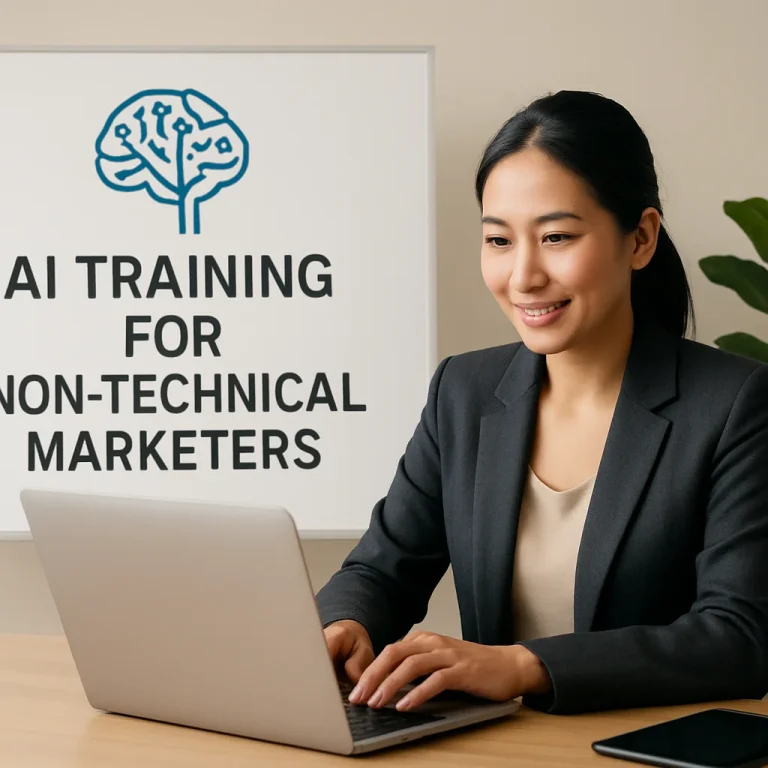
Ai Training For Non Technical Marketers · 4 min read
AI training for non-technical marketers is essential for enhancing marketing strategies and achieving better results. This guide provides insights into effective training methods, tools, and resources tailored for marketers without a technical background. You’ll learn how to leverage AI to optimize campaigns, understand data analytics, and improve customer engagement.
In today’s rapidly evolving digital landscape, AI is no longer just a buzzword; it’s a critical component for marketers. Non-technical marketers can still harness the power of AI without needing deep technical skills. This comprehensive guide will equip you with the knowledge to utilize AI tools effectively, providing you with valuable insights and practical applications for your marketing strategies.
Understanding AI in Marketing
Artificial Intelligence (AI) refers to the simulation of human intelligence in machines programmed to think and learn. In marketing, AI enhances decision-making processes, automates repetitive tasks, and provides deep insights into consumer behavior. AI tools can analyze vast amounts of data, predict trends, and help in personalizing marketing strategies.
Key AI Concepts for Marketers
<!– wp:kadence/listitem {"text":"Machine Learning (ML): A subset of AI that enables systems to learn from data and improve their performance over time.”,”icon”:”fe_chevronRight”,”uniqueID”:”_288711″} –>
<strong>Machine Learning (ML)</strong>: A subset of AI that enables systems to learn from data and improve their performance over time.
<!– wp:kadence/listitem {"text":"Natural Language Processing (NLP): A technology that allows computers to understand and interpret human language, which can be used for chatbots or sentiment analysis.”,”icon”:”fe_chevronRight”,”uniqueID”:”_937168″} –>
<strong>Natural Language Processing (NLP)</strong>: A technology that allows computers to understand and interpret human language, which can be used for chatbots or sentiment analysis.
<!– wp:kadence/listitem {"text":"Predictive Analytics: Techniques that analyze historical data to forecast future outcomes, helping marketers make informed decisions.”,”icon”:”fe_chevronRight”,”uniqueID”:”_7807ac”} –>
<strong>Predictive Analytics</strong>: Techniques that analyze historical data to forecast future outcomes, helping marketers make informed decisions.
Understanding these concepts is critical for non-technical marketers to effectively use AI tools and techniques in their campaigns.
Benefits of AI Training for Non-Technical Marketers
Investing in AI training provides numerous benefits for marketers, including:
<!– wp:kadence/listitem {"text":"Enhanced Decision-Making: AI tools can analyze data at a speed and accuracy that humans cannot match, enabling marketers to make data-driven decisions.”,”icon”:”fe_hash”,”uniqueID”:”_91bd11″} –>
<strong>Enhanced Decision-Making</strong>: AI tools can analyze data at a speed and accuracy that humans cannot match, enabling marketers to make data-driven decisions.
<!– wp:kadence/listitem {"text":"Increased Efficiency: Automation of repetitive tasks saves time and allows marketers to focus on strategy and creative work.”,”icon”:”fe_hash”,”uniqueID”:”_d56454″} –>
<strong>Increased Efficiency</strong>: Automation of repetitive tasks saves time and allows marketers to focus on strategy and creative work.
<!– wp:kadence/listitem {"text":"Improved Customer Insights: AI can analyze customer data to reveal patterns and preferences, leading to more personalized marketing efforts.”,”icon”:”fe_hash”,”uniqueID”:”_7db70b”} –>
<strong>Improved Customer Insights</strong>: AI can analyze customer data to reveal patterns and preferences, leading to more personalized marketing efforts.
<!– wp:kadence/listitem {"text":"Competitive Advantage: Companies leveraging AI effectively can outperform competitors who do not utilize these technologies.”,”icon”:”fe_hash”,”uniqueID”:”_f9bfa5″} –>
<strong>Competitive Advantage</strong>: Companies leveraging AI effectively can outperform competitors who do not utilize these technologies.
By understanding these benefits, non-technical marketers can justify the need for AI training in their professional development.
Types of AI Training Available
There are various formats for AI training tailored specifically for marketers. Here are some effective options:
Online Courses
Online platforms like Coursera, Udemy, and LinkedIn Learning offer courses on AI topics relevant to marketing. For instance:
<!– wp:kadence/listitem {"text":"AI for Everyone by Andrew Ng on Coursera provides a non-technical introduction to AI.”,”icon”:”fe_chevronRight”,”uniqueID”:”_4b5daa”} –>
<strong>AI for Everyone</strong> by Andrew Ng on Coursera provides a non-technical introduction to AI.
<!– wp:kadence/listitem {"text":"Artificial Intelligence in Marketing on Udemy covers practical applications of AI in campaigns.”,”icon”:”fe_chevronRight”,”uniqueID”:”_d0eb70″} –>
<strong>Artificial Intelligence in Marketing</strong> on Udemy covers practical applications of AI in campaigns.
Workshops and Webinars
Many organizations and universities host workshops and webinars focusing on AI applications in marketing. These interactive sessions often provide hands-on experience with AI tools.
Industry Conferences
Attending industry conferences like the AI Expo or Marketing AI Conference can provide valuable networking opportunities and insights from leading experts in the field.
Internal Training Programs
Companies can develop custom training programs tailored to their specific needs. This approach allows for a focus on the tools and strategies most relevant to the organization.
Essential AI Tools for Marketers
To effectively implement AI in marketing strategies, familiarity with relevant tools is crucial. Here’s a look at some essential AI tools:
1. Chatbots
Tools like Drift and Intercom use NLP to facilitate automated customer interactions, answering queries and guiding users through the sales funnel.
2. Predictive Analytics
Platforms like HubSpot and Salesforce Einstein analyze customer data to forecast outcomes and tailor marketing campaigns accordingly.
3. Content Creation
AI-driven tools such as Copy.ai and Jasper assist in creating compelling content by generating copy based on user prompts.
4. Social Media Management
Tools like Hootsuite and Buffer incorporate AI to optimize posting schedules and analyze engagement metrics.
Familiarity with these tools can significantly enhance a marketer’s ability to engage with customers and optimize campaigns.
Integrating AI into Marketing Strategies
Integrating AI into your marketing strategy requires a structured approach. Here’s a step-by-step process:
<!– wp:kadence/listitem {"text":"Identify Pain Points: Analyze your current marketing processes and identify areas where AI can add value, such as customer engagement or data analysis.”,”icon”:”fe_hash”,”uniqueID”:”_859737″} –>
<strong>Identify Pain Points</strong>: Analyze your current marketing processes and identify areas where AI can add value, such as customer engagement or data analysis.
<!– wp:kadence/listitem {"text":"Choose the Right Tools: Based on identified pain points, select the appropriate AI tools that align with your marketing goals.”,”icon”:”fe_hash”,”uniqueID”:”_e336b8″} –>
<strong>Choose the Right Tools</strong>: Based on identified pain points, select the appropriate AI tools that align with your marketing goals.
<!– wp:kadence/listitem {"text":"Train Your Team: Ensure your marketing team is educated about the chosen tools and their applications. Conduct training sessions and provide resources for continuous learning.”,”icon”:”fe_hash”,”uniqueID”:”_a4d470″} –>
<strong>Train Your Team</strong>: Ensure your marketing team is educated about the chosen tools and their applications. Conduct training sessions and provide resources for continuous learning.
<!– wp:kadence/listitem {"text":"Monitor Performance: Regularly assess the performance of AI tools in your marketing campaigns. Use metrics to evaluate effectiveness and make necessary adjustments.”,”icon”:”fe_hash”,”uniqueID”:”_4ac0ca”} –>
<strong>Monitor Performance</strong>: Regularly assess the performance of AI tools in your marketing campaigns. Use metrics to evaluate effectiveness and make necessary adjustments.
<!– wp:kadence/listitem {"text":"Iterate and Improve: AI tools are continually evolving. Stay updated on new features and best practices to optimize your strategies continuously.”,”icon”:”fe_hash”,”uniqueID”:”_d66eee”} –>
<strong>Iterate and Improve</strong>: AI tools are continually evolving. Stay updated on new features and best practices to optimize your strategies continuously.
By following this structured approach, non-technical marketers can effectively implement AI into their marketing strategies.
Overcoming Challenges in AI Adoption
While the benefits of AI are substantial, there are challenges to consider:
<!– wp:kadence/listitem {"text":"Data Quality: AI relies on data for accuracy. Poor-quality data can lead to ineffective decision-making.”,”icon”:”fe_chevronRight”,”uniqueID”:”_f2ca7d”} –>
<strong>Data Quality</strong>: AI relies on data for accuracy. Poor-quality data can lead to ineffective decision-making.
<!– wp:kadence/listitem {"text":"Integration with Existing Systems: Ensuring that AI tools work seamlessly with current marketing platforms can be complex.”,”icon”:”fe_chevronRight”,”uniqueID”:”_ce2db1″} –>
<strong>Integration with Existing Systems</strong>: Ensuring that AI tools work seamlessly with current marketing platforms can be complex.
<!– wp:kadence/listitem {"text":"Skill Gaps: Non-technical marketers may face a learning curve when adapting to AI technologies.”,”icon”:”fe_chevronRight”,”uniqueID”:”_914a0e”} –>
<strong>Skill Gaps</strong>: Non-technical marketers may face a learning curve when adapting to AI technologies.
Addressing these challenges proactively can facilitate smoother AI adoption.
Case Studies: Successful AI Implementation in Marketing
Case Study 1: Sephora
Sephora uses AI-powered chatbots on its website and mobile app to provide personalized product recommendations. By analyzing user preferences and purchase history, the chatbot enhances customer engagement and drives sales.
Case Study 2: Netflix
Netflix employs AI algorithms to analyze viewer preferences and recommend content. This personalized approach has significantly increased user engagement and retention.
These real-world examples illustrate how effective AI implementation can lead to improved marketing outcomes.
Future Trends in AI for Marketing
As AI technology continues to evolve, several trends are emerging that will shape the future of marketing:
<!– wp:kadence/listitem {"text":"Increased Personalization: AI will further refine customer segmentation and targeting, allowing for hyper-personalized marketing messages.”,”icon”:”fe_chevronRight”,”uniqueID”:”_429af7″} –>
<strong>Increased Personalization</strong>: AI will further refine customer segmentation and targeting, allowing for hyper-personalized marketing messages.
<!– wp:kadence/listitem {"text":"Voice Search Optimization: As voice search becomes more prevalent, marketers will need to adapt their strategies to cater to voice-activated searches.”,”icon”:”fe_chevronRight”,”uniqueID”:”_cc04bc”} –>
<strong>Voice Search Optimization</strong>: As voice search becomes more prevalent, marketers will need to adapt their strategies to cater to voice-activated searches.
<!– wp:kadence/listitem {"text":"Ethical AI Use: There will be a growing focus on ethical AI practices, ensuring transparency and fairness in AI-driven marketing efforts.”,”icon”:”fe_chevronRight”,”uniqueID”:”_8d8761″} –>
<strong>Ethical AI Use</strong>: There will be a growing focus on ethical AI practices, ensuring transparency and fairness in AI-driven marketing efforts.
Staying abreast of these trends will help marketers remain competitive in an AI-driven landscape.
Conclusion
AI training for non-technical marketers is essential for staying relevant in today’s marketing environment. By harnessing AI tools and techniques, marketers can enhance their strategies, improve customer engagement, and drive better results. As technology continues to advance, ongoing education in AI will be crucial for success.
Image Suggestions
[IMAGE: AI tools for marketers + alt text: AI tools for marketing strategies]
[IMAGE: Chatbots in action + alt text: Example of chatbot interaction]
[IMAGE: Data analytics dashboard + alt text: Marketing data analytics dashboard]
Key Takeaways
AI enhances marketing efficiency and decision-making.
Various training formats are available for non-technical marketers.
Real-world examples demonstrate effective AI implementation.
Frequently Asked Questions
AI training for non-technical marketers is focused on teaching marketing professionals how to utilize AI tools and techniques without requiring a technical background.
The duration of AI training can vary, but online courses often range from a few hours to several weeks, depending on the depth of the content.
Useful AI tools for marketers include chatbots, predictive analytics platforms, content creation tools, and social media management software.
Yes, with the right training and tools, non-technical marketers can effectively leverage AI to enhance their marketing strategies.
Costs for AI training can vary widely, with some online courses available for free and others costing several hundred dollars.
Following industry blogs, attending webinars, and joining professional organizations can help you stay informed about the latest AI trends in marketing.
Ready to elevate your marketing skills with AI? Explore our comprehensive AI training resources tailored for non-technical marketers and start transforming your strategies today!
Enjoy our AI education and solutions in Asia tips? Subscribe for more!
AI Training For Non Technical Marketers Ai Training For Non Technical Marketers · 4 min read AI training for non-technical marketers is essential for navigating the evolving landscape of digital marketing. By understanding AI tools and strategies, marketers can enhance their campaigns, optimize customer engagement, and drive better results. This article outlines best practices for…
Ai Training For Non Technical Marketers Ai Training For Non Technical Marketers · 4 min read AI training for non-technical marketers equips professionals with the essential knowledge to implement AI tools and strategies effectively. This article outlines the benefits of tailored AI marketing courses, specifically designed for leadership roles, and highlights actionable strategies that executives…
Discover how artificial intelligence is transforming the travel industry in 2025 — from AI trip planners to smart price prediction and real-time translation.